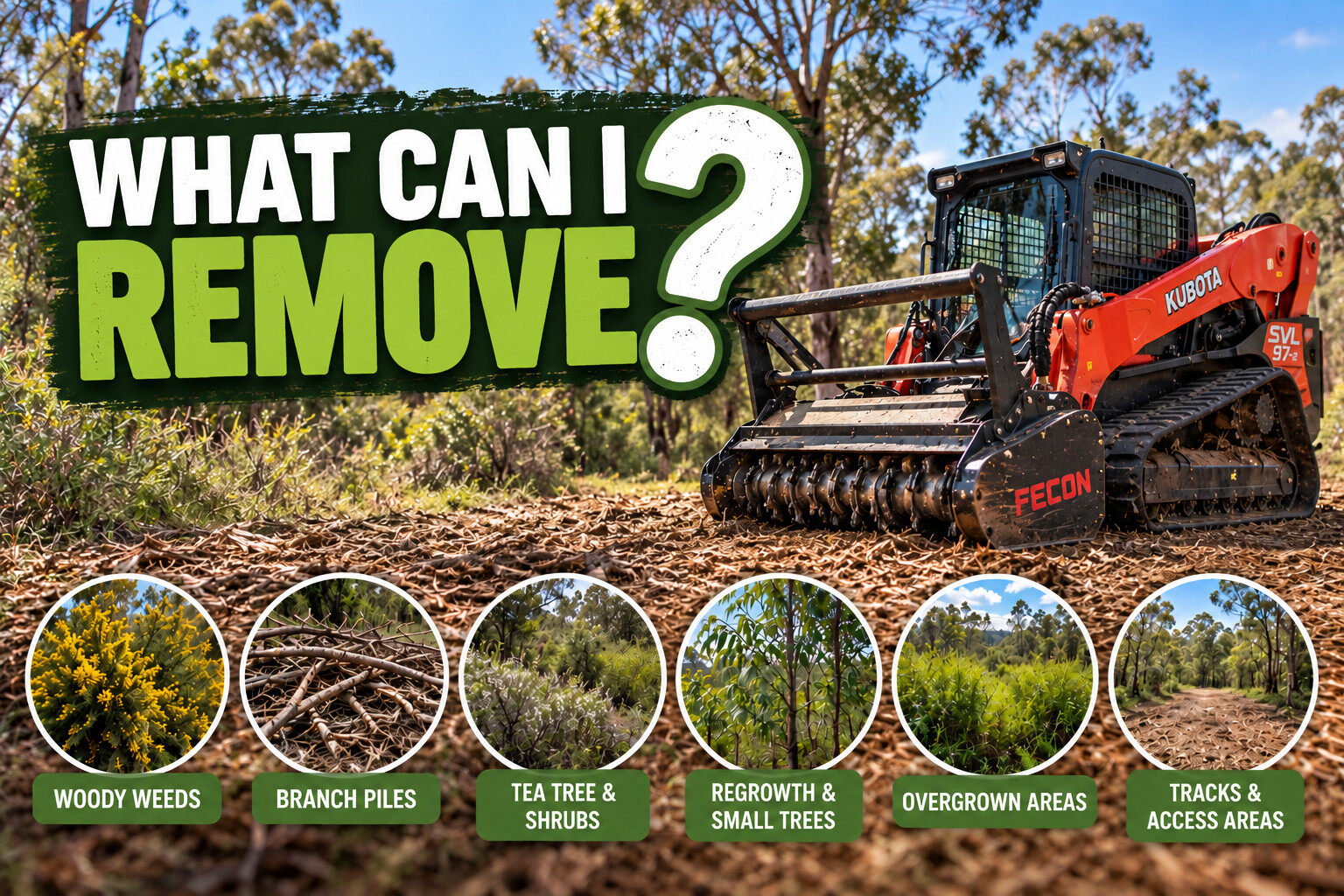
A practical guide to planning overlays, invasive weeds, native vegetation, bushfire preparation and what's possible with forestry mulching.
One of the most common questions I get from property owners is:
"What am I actually allowed to clear on my property?"
It's a good question, and unfortunately, there's not always a straightforward answer.
Whether you've got tea tree spreading through your paddocks, blackberry taking over, overgrown bush around your house or tracks that have disappeared under vegetation, knowing what you can and can't remove can be confusing.
A lot of people are surprised to learn that owning a property doesn't automatically mean you can clear whatever you like.
But that doesn't necessarily mean you can't do anything.
There are often more options worth exploring than people realise.
I work with property owners throughout Geelong, the Surf Coast, Bellarine, Otways and surrounding areas, helping them manage overgrown land, tackle invasive weeds and make better use of their properties.
Here's a practical guide to understanding your options and where to start.
1. Start by checking your property's planning overlays
Before removing vegetation, it's worth understanding what planning controls apply to your property.
Different properties can have very different requirements, even when they're located close to one another.
Some of the overlays you might encounter include:
Bushfire Management Overlay (BMO)
Identifies areas where bushfire hazards need to be considered in planning decisions. It can affect development requirements, but doesn't automatically give landowners permission to clear vegetation.
Environmental Significance Overlay (ESO)
Protects areas with particular environmental values. Depending on the schedule applying to your property, vegetation removal may require approval.
Vegetation Protection Overlay (VPO)
Protects significant vegetation, which may include individual trees or larger areas of vegetation.
Significant Landscape Overlay (SLO)
Protects important landscape characteristics. Vegetation removal can be controlled where it would affect those characteristics.
Heritage Overlay (HO)
Can also be relevant where vegetation forms part of a protected heritage place.
It's possible for a property to have several overlays applying at once.
How do you check your overlays?
The Victorian Government provides a free mapping system called VicPlan.
You can search your address and generate a Planning Property Report showing the planning zone, overlays and other relevant information.
Official resource: Victorian Government — Planning Property Reports and VicPlan
The report is a useful starting point, but it's important to remember that overlays aren't the only consideration.
Native vegetation provisions, planning scheme requirements and other environmental protections may still apply.
When discussing a potential job, I'm happy to take an initial look at your property's overlays and identify anything that might warrant further investigation.
I can't provide formal planning approval, but I can help you understand what questions need answering before we begin.
2. Understanding declared weeds and environmental weeds
This is an area where things can get particularly interesting.
Not every plant considered a weed is legally classified in the same way.
In Victoria, there are two important concepts to understand.
Declared noxious weeds
These are plants declared under Victoria's Catchment and Land Protection Act 1994.
There are four categories:
- State prohibited weeds
- Regionally prohibited weeds
- Regionally controlled weeds
- Restricted weeds
Different categories have different legal requirements, and classifications can vary between catchment regions.
Landowners may have legal responsibilities to control certain declared weeds on their properties.
Official resource: Agriculture Victoria — Declared Noxious Weeds List
Environmental weeds
Environmental weeds are plants that threaten natural ecosystems by spreading into areas where they don't belong.
They can compete with indigenous vegetation, reduce biodiversity and change habitat conditions.
Some are introduced from overseas.
Others are Australian native plants that have become invasive outside their natural distribution.
Importantly, a plant can be an environmental weed without being a declared noxious weed.
And appearing on a weed list doesn't automatically override planning requirements or mean every removal method is permitted.
Official resource: Victorian Government — Environmental Weed Risk Ratings
3. Common invasive weeds across Geelong, Surf Coast and the Otways
Across our region, there are numerous invasive plants that can become significant problems for property owners.
Some are particularly suited to forestry mulching, while others require different treatment methods.
Here are some worth knowing about.
Gorse
Gorse is one of the most troublesome woody weeds we encounter.
It's a dense, thorny shrub with bright yellow flowers that can form extensive infestations.
I regularly drive past paddocks where patches of gorse have gradually spread, becoming thicker and taking over more of the property.
We also encounter it in established bushland, where it can compete with native vegetation.
Forestry mulching can be particularly effective for tackling large, heavily infested areas.
It can help knock down dense growth and reopen areas that have become difficult to access.
However, gorse has a persistent seed bank, so ongoing monitoring and follow-up treatment are essential.
Blackberry
Blackberry is another common problem throughout the Otways and surrounding rural areas.
It can form dense, thorny thickets that restrict access, compete with other vegetation and spread along waterways, fence lines and forest edges.
For extensive infestations, forestry mulching can help reduce the bulk of the vegetation and improve access for follow-up control.
However, blackberry can regrow from its root system, so mulching alone isn't generally a complete long-term solution.
Boneseed
Boneseed is an invasive shrub with bright yellow flowers.
It's particularly problematic in coastal and bushland environments, where it can compete with indigenous vegetation.
It can form dense stands and produce large quantities of seed.
Mechanical removal may be appropriate in some situations, but treatment needs to account for seed production, soil disturbance and follow-up management.
Sallow wattle
Sallow wattle is an interesting example because it's an Australian native species that can become invasive outside its natural range.
In parts of the Surf Coast, it can spread into native vegetation communities and compete with locally indigenous plants.
It's important to distinguish invasive sallow wattle from other native wattles before undertaking removal.
Sweet pittosporum
Sweet pittosporum is another Australian native species that can become an environmental weed outside its natural distribution.
It can establish beneath existing tree canopies and gradually form dense stands.
Its fruit is dispersed by birds, helping it spread into surrounding bushland.
Coastal tea tree
Coastal tea tree can be another confusing species for property owners.
It occurs naturally in some coastal environments but can be invasive outside its indigenous range.
It can form dense stands that alter the structure of existing vegetation communities.
However, not all tea tree is invasive, and different species have different ecological values.
Correct identification and an understanding of the property's location are essential before considering removal.
Other weeds worth knowing about
Depending on the property and local environment, landowners may also encounter:
| Weed | Common issue |
|---|---|
| Spanish heath | Can invade heathland and bushland |
| Cape broom and English broom | Woody shrubs that can form dense infestations |
| African boxthorn | Thorny shrub that restricts access and can spread through farmland |
| Hawthorn | Can form dense woody growth along paddocks and waterways |
| Sweet briar | Thorny shrub that can invade pasture and bushland |
| Bridal creeper | Climbing plant that can smother indigenous vegetation |
| English ivy | Can spread across the ground and climb established trees |
| Mirror bush | Can invade coastal vegetation |
| Agapanthus | Can spread from gardens into natural areas |
| Cotoneaster | Bird-dispersed shrub that can establish in bushland |
| Serrated tussock | Invasive grass that can seriously affect grazing land |
| Chilean needle grass | Invasive pasture grass that can spread through seed contamination |
| Pampas grass | Large invasive grass that can establish in disturbed areas |
| Ragwort | Pasture weed that can be harmful to livestock |
| Willows | Some species can affect waterways and riparian vegetation |
This isn't a complete list, and not all these species are suitable for forestry mulching.
The best treatment depends on the plant, the infestation and the surrounding environment.
4. Find the weed lists for your local council
One of the most useful things property owners can do is look at the weed information published for their particular area.
Different regions have different priority species.
Surf Coast Shire
Surf Coast Shire has particularly useful resources because it provides separate guides for different parts of the municipality.
These include:
- Jan Juc, Torquay, Bellbrae and Connewarre
- Anglesea to Eastern View
- Lorne, Deans Marsh and Bambra
- Moriac, Freshwater Creek, Winchelsea and Barrabool Hills
Each guide identifies 20 significant weeds for that part of the shire.
View the guides: Weeds of the Surf Coast Shire
Colac Otway Shire
Colac Otway Shire provides significant weed guides for three different landscapes:
- Coast
- Foothills and ranges
- Plains and stony rises
These are particularly useful because vegetation and weed problems can vary substantially between coastal properties, agricultural land and the wetter Otway ranges.
View the guides: Colac Otway Shire — Weed Management
City of Greater Geelong
The City of Greater Geelong publishes a detailed environmental weed list.
It includes plants such as sallow wattle, coastal tea tree, sweet pittosporum, agapanthus, mirror bush and various other species.
This can be particularly useful for owners of bush blocks, lifestyle properties and acreage around Geelong.
View the list: City of Greater Geelong — Environmental Weeds
Bellarine Peninsula
The Bellarine Catchment Network provides local weed identification resources, including information about environmental weeds affecting the peninsula.
These are useful for properties around Ocean Grove, Barwon Heads, Drysdale, Portarlington and surrounding areas.
View the resources: Bellarine Catchment Network — Pest Plants and Animals
Golden Plains Shire
Golden Plains Shire provides information about declared weeds, environmental weeds and landholder responsibilities.
It also has a regional weed field guide.
View the resources: Golden Plains Shire — Weeds and Pest Animals
Corangamite Shire
Corangamite Shire provides information about declared weeds, weed management responsibilities and reporting infestations.
View the resources: Corangamite Shire — Weed and Pest Management
Statewide identification resources
If you're unsure what a particular plant is, Agriculture Victoria has an extensive database of invasive plants.
You can search by common name and find information about identification, distribution and management.
View the database: Agriculture Victoria — Invasive Plants A–Z
5. Can I remove tea tree, bracken and other native vegetation?
This is another question I get regularly.
A property might have dense tea tree, bracken, wattles or other native vegetation spreading through areas that were previously more open.
Sometimes owners want to reopen an old track, improve access or manage vegetation around established trees.
But it's important to distinguish between unwanted vegetation and vegetation that can legally be removed.
A plant doesn't become a weed simply because it's growing somewhere you don't want it.
Native vegetation can have important environmental values even when it's dense or difficult to manage.
Bracken, for example, is naturally occurring in many Victorian environments.
It isn't automatically an invasive weed, and removing it can affect habitat and soil conditions.
Similarly, different species of tea tree and wattle can have very different ecological values.
That's why I prefer to assess properties individually.
Sometimes selective vegetation management is possible, retaining established trees and important vegetation while addressing areas where clearing is permitted.
Other times, further ecological or planning advice is needed.
The goal isn't necessarily to clear everything. It's to find an appropriate way to manage the property while retaining the features that make it special.
6. What vegetation can I remove for bushfire protection?
Bushfire preparation is an important consideration for many property owners across our region.
Victoria has specific planning provisions that may allow certain vegetation removal around eligible existing buildings.
Two commonly discussed exemptions are the 10/30 and 10/50 rules.
What is the 10/30 rule?
In certain designated bushfire-prone areas, eligible landowners may be able to remove vegetation within specified distances of an existing accommodation building without a planning permit.
Broadly, the rule refers to:
- Any vegetation, including trees, within 10 metres of an eligible existing building
- Vegetation other than trees within 30 metres of that building
However, eligibility depends on the building, relevant dates and other conditions.
What is the 10/50 rule?
In certain circumstances, a different exemption may apply to eligible buildings within a Bushfire Management Overlay.
Broadly, it refers to:
- Any vegetation, including trees, within 10 metres of an eligible existing building
- Vegetation other than trees within 50 metres of that building
Again, the exemption is subject to specific conditions.
Neither rule should be treated as automatic permission to clear vegetation simply because a property is in a bushfire-prone area or BMO.
Other legal protections and restrictions may also apply.
Official guidance: Victorian Government — Vegetation Removal for Bushfire Protection
What if the CFA has recommended vegetation management?
Many property owners seek advice about preparing their homes and surrounding land for bushfire.
That advice can be a valuable starting point.
Depending on what's permitted, forestry mulching may help with:
- Managing dense woody vegetation
- Opening up access tracks
- Maintaining previously cleared areas
- Removing suitable woody weeds
- Improving access around established trees
- Processing suitable accumulated branches and vegetation
However, CFA preparedness advice doesn't automatically constitute planning approval.
Any necessary approvals or exemptions need to be confirmed before work begins.
7. Can I mulch existing burn piles instead of burning them?
This is something that often surprises property owners.
We regularly come across properties where owners have spent weekends cutting back trees, branches and overgrown vegetation, piling everything up with plans to burn it later.
But between work, family commitments, weather conditions and finding a suitable time to burn, those piles can sit there for months.
And once the declared Fire Danger Period begins, burning may no longer be an option without the appropriate authorisation.
What many people don't realise is that we can often mulch through suitable existing burn piles instead.
Depending on the material, pile size and access, our forestry mulcher can process accumulated branches and woody vegetation directly on site.
It's particularly handy when we're already on the property tackling other vegetation management work.
Not every pile is suitable, especially where there are rocks, wire, rubbish, excessive soil or oversized timber.
The resulting mulch also needs to be managed appropriately, particularly around buildings and other bushfire-sensitive areas.
But if you've got piles of branches you've been meaning to burn, it's certainly worth asking whether forestry mulching could be an option.
8. What can forestry mulching actually achieve?
One of the biggest advantages of forestry mulching is how much work the machinery can achieve in a relatively short period.
Many property owners contact me because they've been looking at the same overgrown areas for years.
They might have spent weekends cutting back vegetation, dragging branches, using a brushcutter or trying to reopen old tracks.
It's exhausting work, particularly on larger properties.
With the right machinery, work that might take weeks of manual labour can sometimes be achieved in a single day.
Forestry mulching uses specialised machinery to cut and process suitable vegetation on site.
Depending on the property, it can help:
- Open up overgrown paddocks
- Manage extensive woody weed infestations
- Selectively remove suitable smaller trees and shrubs
- Reopen existing tracks
- Improve access through overgrown areas
- Manage vegetation around established trees
- Process suitable existing burn piles
- Maintain vegetation around buildings where permitted
Not every property is suitable for the machine.
Steep terrain, large trees, hidden rocks, fencing, underground services and environmentally sensitive areas can all affect what's possible.
That's why I generally prefer to assess a property before providing a firm quote.
9. Why follow-up weed management matters
One important thing I always encourage property owners to understand is that removing the visible vegetation isn't necessarily the end of the job.
Many invasive plants are persistent.
Blackberry can regrow from its root system.
Gorse can germinate from seeds that have remained in the soil for years.
Other woody weeds may resprout or establish again from surrounding seed sources.
Forestry mulching can be an excellent first step, particularly for dense infestations where access is difficult.
But depending on the species, follow-up treatment may involve targeted weed control, monitoring, revegetation or other management techniques.
For larger properties, developing a longer-term approach can make an enormous difference.
It's also important to avoid spreading weed seeds or contaminated material between areas or properties.
10. Not sure where to start? That's where I can help.
One of the things I enjoy most about this work is helping property owners figure out how to make better use of their land.
Sometimes that means opening up an overgrown paddock, managing invasive weeds or creating better access around established trees.
Other times, it's helping someone who's just bought a property, has received bushfire preparation advice or simply doesn't know where to start with years of overgrown vegetation.
You don't need to have everything figured out before giving me a call.
I'm happy to have a chat, take an initial look at your property and arrange a site visit where appropriate.
We can walk around together, discuss what you'd like to achieve, identify what the machinery can realistically do and flag anything that might need checking with council or a specialist before work begins.
From there, I can provide a clear scope, quote and timeframe.
And quite often, work that might have taken months of weekends can be achieved in just a day or two.
Got an overgrown property, unwanted vegetation or existing burn piles you're not sure how to tackle?
Give me a call or send through your property location and a few photographs.
Let's see what's possible.
Cheers,
Lachy
Otway Forestry Mulching
📞 0491 173 361
Servicing Geelong, Surf Coast, Otways, Bellarine and surrounding areas.