Across Victoria right now, skies are thick with smoke and hearts are heavy with concern. Fires ripping through communities, from the north-east to the Otways, are among the worst we have seen, tragically destroying homes, property and landscapes while crews and volunteers work around the clock.
My thoughts are with everyone impacted, and with every volunteer, emergency service worker, neighbour, family member and friend doing everything they can to keep others safe. Your courage and sacrifice inspire us all.
In the middle of this, through Otway Forestry Mulching, we are grateful to support landowners in practical ways. We are invited onto properties where people are anxious about fuel build-up and fire safety. We are not just clearing vegetation. We are helping create defensible space around homes and infrastructure, and partnering with people who care deeply about their land and community safety. This work is not about glamour. It is about showing up in practical, respectful ways at times when it matters most.
There is an ongoing public and political conversation about bushfire risk, fuel loads and how best to reduce that risk. Much of it traces back to recommendations following the Black Saturday bushfires in 2009, where a fuel-reduction target of treating 5 per cent of public land annually was highlighted.
In recent years, Victorian agencies have not consistently reached that target, which has fuelled community debate. Some people have raised concerns about rising fuel loads leading into the 2025 fire season. At the same time, government agencies emphasise that they use a science-based, targeted approach to keep overall fuel-driven bushfire risk below agreed thresholds, and that prescribed burning is only one of several fuel-management tools being used.
The Bushfire Risk Management Report 2023–24 shows that 316 planned burns were completed, treating 122,291 hectares for fuel-reduction purposes in 2023–24. In addition, 1,602 non-burn fuel treatments, including slashing and mowing, treated approximately 16,163 hectares. This data highlights that fuel management in Victoria already includes mechanical methods alongside traditional burning, even if public reporting tends to focus more heavily on prescribed fire statistics.
What the data also makes clear is that reducing bushfire risk is a complex, year-round task, and no single tool can address every situation. Prescribed burning is effective in some locations and conditions, while mechanical treatments play a critical role where burns are not safe or feasible.
In public discussions, there are often claims that environmental concerns, sometimes framed dismissively as 'greenies', prevent fuel reduction from happening. The reality is far more nuanced. Modern fuel-management approaches increasingly recognise that environmental protection and fire risk reduction are not opposing goals. In many cases, fuel-reduction methods are deliberately designed to reduce risk while minimising ecological harm.
Prescribed burning remains an important tool, but it is not suitable everywhere. Smoke impacts on nearby communities, risks close to homes and infrastructure, limited weather windows, and potential damage to sensitive ecosystems can all restrict where and when burns can safely occur.
This is where mechanical fuel treatments, such as mulching and slashing, become especially valuable. These methods reduce fuel loads without fire or smoke, allow for highly targeted and selective treatment, protect canopy trees, waterways and sensitive habitat, and are often safer near homes, roads and infrastructure. They can also be delivered with smaller crews and fewer constraints than prescribed burns.
Rather than being anti fuel reduction, many environmentally informed approaches are about choosing the right tool for the right place, balancing immediate safety with long-term land health.
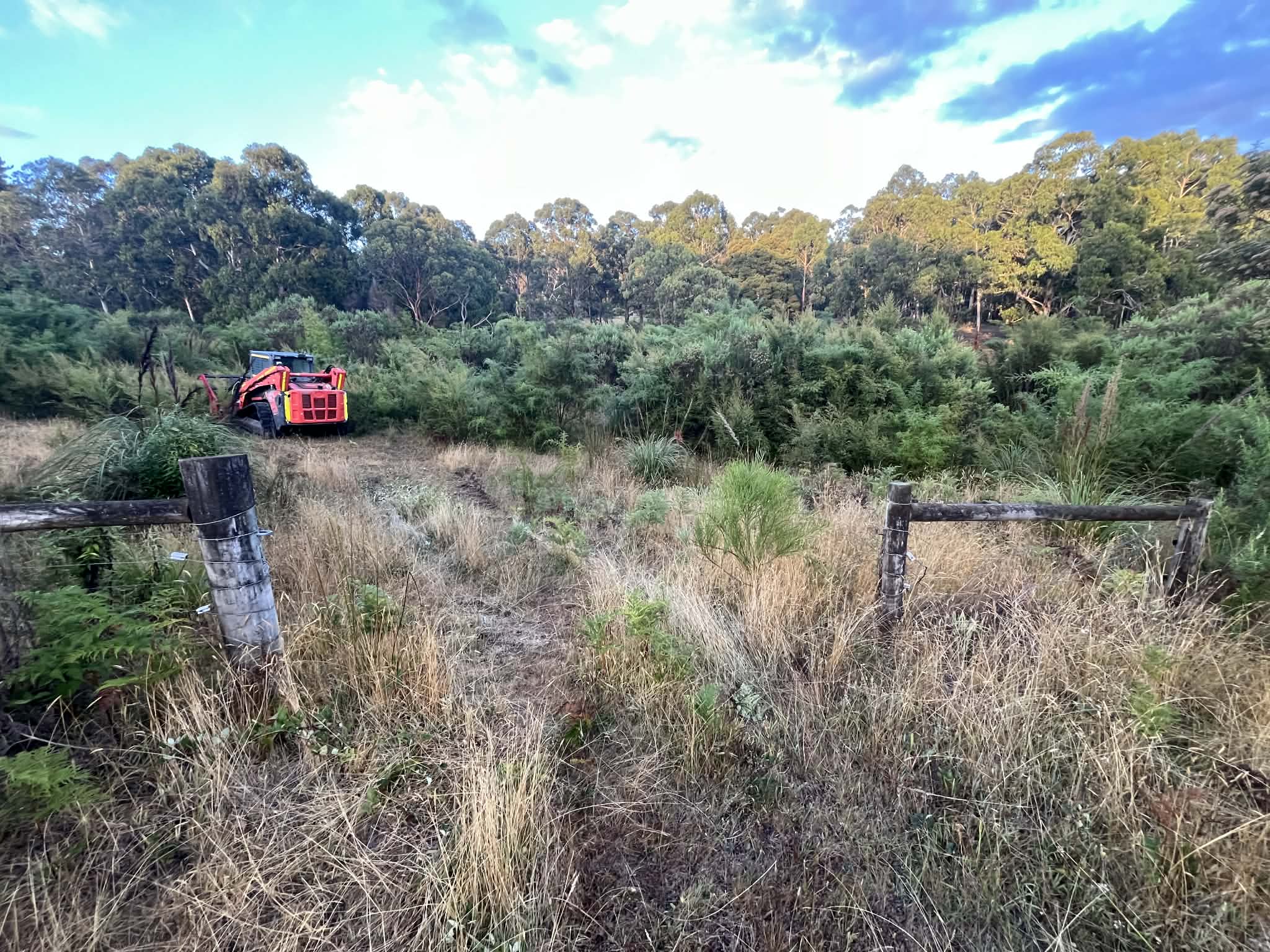
Forestry mulching is one of the mechanical fuel-reduction methods used by fuel-management programs, councils, landholders and emergency services. It involves grinding vegetation into mulch, reducing fuel loads without fire or smoke, and can be applied year-round in most conditions, although in very wet, muddy weather even we get bogged.
What makes forestry mulching particularly valuable is its precision and flexibility. It can be tailored to work around native trees, waterways, and culturally or ecologically sensitive areas, while leaving protective mulch on the ground rather than exposing bare soil. It is especially useful for creating defensible space close to homes, access tracks, fence lines and strategic fuel breaks. Mechanical treatments like mulching and slashing already form part of Victoria's fuel-management toolkit, and there is growing recognition of their role in complementing prescribed burns.
This conversation is not about picking sides or assigning blame. Fire risk management in a landscape like Victoria's is shaped by many interconnected factors, including long-term drought and climate influences, vegetation types and fuel connectivity, population growth in bushfire-interface areas, community preparedness, and the availability of safe windows for prescribed burning.
The key point is that effective fuel reduction is multifaceted. Prescribed burns, mechanical treatments, strategic fire breaks, defensible planning, community preparedness and ongoing risk assessment all contribute to a balanced, resilient approach.
To everyone impacted by fire this season, whether a property owner, volunteer firefighter, neighbour or supporter, we see your determination and sacrifice. Community safety is not the responsibility of any one person or agency. It is a shared responsibility for all of us who live on this land.
At Otway Forestry Mulching, we are committed to continuing to provide practical, respectful and environmentally considerate fuel-management solutions that support broader strategies, helping to keep people, properties and this incredible landscape safer for years to come.